
Multi-Tiered Systems of Support: Meeting Students Where They Are


Education is the home of many acronyms. On any given day, you might overhear teachers discussing OG, UFLI, PATs, IPPs, SLDs, ADHD, CBMs, and so on. We really seem to love our acronyms! One of the terms that you might have heard lately is MTSS, which stands for Multi-Tiered Systems of Support. This is a school-wide system that is designed to ensure that every student receives the support that they need. In an MTSS model, teachers and school staff meet students where they are - and provide the instruction needed so that students can reach their highest potential.
As you’d expect from the name, a Multi-Tiered System of Support is organized into tiers. We often use a triangle to visually represent these tiers; you can see this in the diagram below. Tier 1 is core instruction that includes the whole class; teachers use evidence-based instruction and provide universal support, such as visual schedules or mathematical manipulatives, for all students. Teachers regularly monitor progress and move students to Tier 2 for extra support or targeted remediation when needed. This remediation, which is also evidence-based, often takes place in a smaller group setting so that teachers can better provide targeted instruction designed to address specific skill gaps. Tier 2 remediation is loosely connected to the curriculum and targets skills and knowledge needed for strong foundations in the three strands that connect learning across different subjects: reading, writing, and mathematics. If students continue to struggle or if assessments show larger gaps than originally identified, students move to Tier 3 for intensive intervention. This is provided by highly trained teachers/instructors who design explicit instruction based on assessment data to meet the needs of individual students. This intervention is non-curricular and targets the root causes of academic difficulty; instructors focus on building the core systems of literacy and numeracy for lifelong learning. Tier 3 instruction may be delivered 1:1 or in a small group.
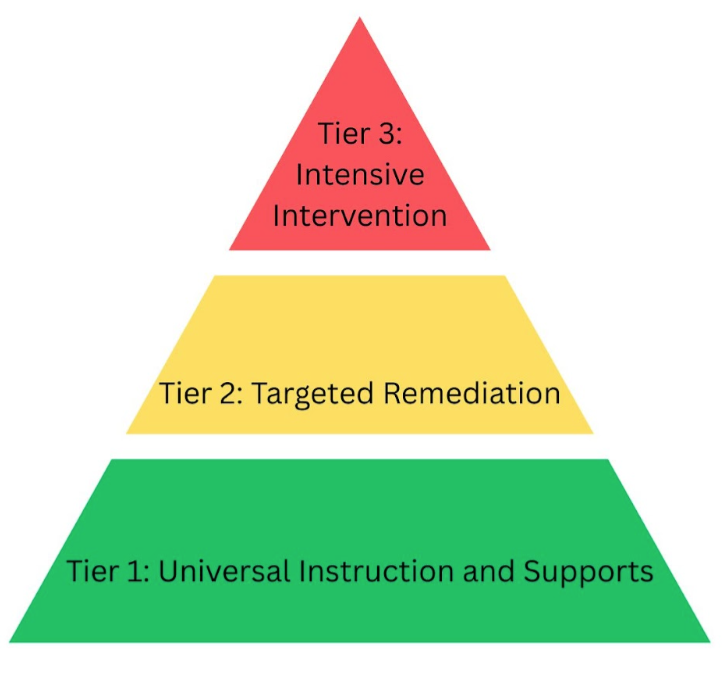
At Foothills Academy, our core instruction at Tier 1 is enhanced by a class cap size of 14 students and a teacher and education assistant in every elementary classroom, and a teacher and half-time education assistant in every junior high and high school classroom. Our Tier 2 remediation is provided by teachers, education assistants, and the Literacy & Numeracy Strategist. One of the features of our program at Foothills Academy is our Skills Class for grades 3-9. In this class, students are sorted into small groups each term for Tier 2 instruction in reading, writing, or math. Some students take part in remedial instruction in all three areas; some repeat topics, and some move to Tier 3 for intensive intervention instruction instead.
Through our partnership with the Read/Write & Math Intervention department, Tier 3 instruction is provided by highly trained interventionists who design personalized programs for the students in their care. At Foothills Academy, all of our students have a diagnosed Learning Disability, so we are able to maximize Tier 3 instruction by grouping students with similar needs. These groups have a maximum of four students with one instructor. In all tiers, we use evidence-based instruction, supports, and accommodations to ensure that all students thrive.
One of the most important parts of MTSS at Foothills Academy is the use of data and ongoing communication; teachers monitor progress and adjust instruction as needed, keeping parents informed along the way. MTSS encourages teamwork among teachers, specialists, and families. By identifying needs early and providing the right support at the right time, MTSS helps students build confidence, strengthen skills, and reach their fullest potential, both at school and beyond.
References and Further Resources:
A Comprehensive Guide to MTSS Interventions in K-12 Education